
There has always been a contentious trade-off between extracting utility from a user’s data and preserving their privacy— what if you could do both? This article gives an introduction to Fully Homomorphic Encryption (FHE), a family of encryption schemes that allows users to perform computations on encrypted data, upending the utility-privacy trade-offs.
The theory was first floated around in the late 70s (notably, by R and A of the RSA encryption team) but the first functional scheme was only proposed in 2009 by Craig Gentry. It was offensively inefficient, with multiplications of two encrypted numbers taking minutes. Since then, the pace of improvements and iterations has been ramping up and FHE has gone from prohibitively expensive to just impractical. With all it promises— whether in privacy-preserving ML, encrypted blockchains, or others— it’s becoming an important part of the conversation on privacy. So, read on!

Traditionally, if an application had to perform some computation on encrypted data, the application would have to decrypt the data first, perform the desired task on the plaintext data, and then re-encrypt the data. When working with trusted third-parties, that works well. However, it introduces issues when you don’t trust the guys on the other side. For example, I’d be all about using my genomic data to further science but I don’t know who’s getting their grubby little hands on my GATTACAs after I dutifully spit in a sample tube.

FHE’s proposal is to remove the application’s need to decrypt anything. This works by finding ways to encrypt data so that you can apply functions +_{enc} and \times_{enc} that maintain the same properties as normal addition and multiplication when you do them over the encrypted data (hence, the name homomorphic— maintaining the same shape). If you can do that, you can work on encrypted data, and, on decryption, get a matching output. For example,
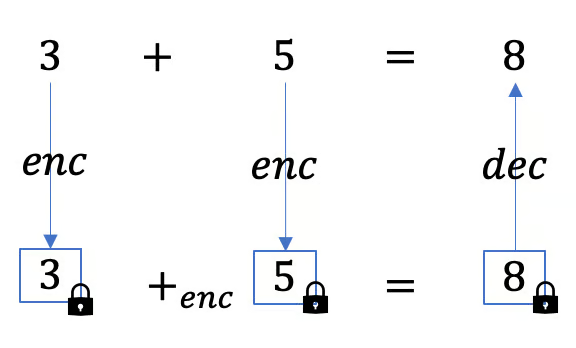
I can encrypt the values $3$ and $5$, and make someone compute $3 + 5$ on those encrypted inputs without them knowing what they’re actually adding. The result to that computation, however, can be decrypted to the plaintext output by whoever has the key.
“Why addition and multiplication?”, you might ask. It turns out these two operations are computationally complete, meaning that any computation can be expressed as combinations of these so that— more generically— for any computation $f$ (and its equivalent on encrypted data, $f_{enc}$) on a message $m$, you get something like this:
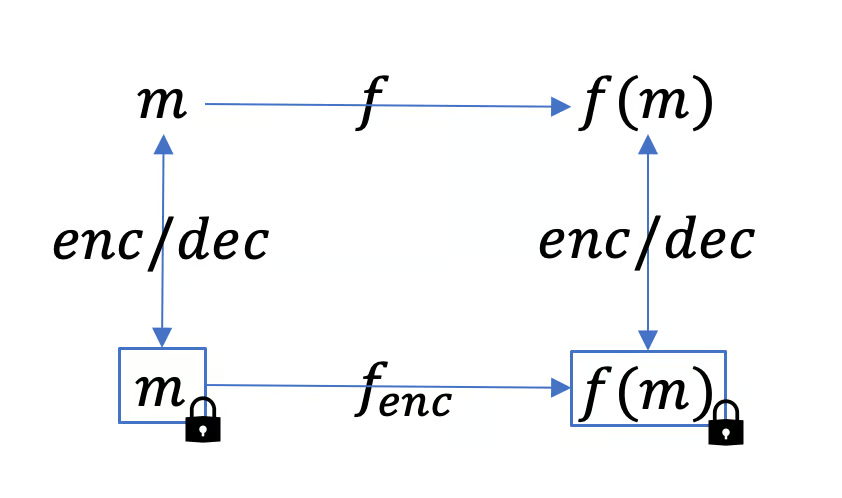
I could encrypt my message $m$, send it to some snakey third-party that won’t be able to decipher it but will still be able to produce something useful by applying $f_{enc}$ on it. In this example, if I have the key, I can then decipher what I get back.
Seeing this, we get an idea of how FHE can have an enormous impact on how we understand data privacy. For example, users would be able to offload expensive computations to cloud providers in such a way that the providers would not have access to the plaintext data at all.
In a nutshell, this lets multiple parties work collaboratively on data without having to trust each other. Unapologetically, we’ll start with Web3 use cases ¯\(ツ)/¯
Recently very popular, Zero Knowledge (ZK) has been sold in every shape and form as crypto’s solution to privacy. It will undoubtedly play a huge part in increasing the privacy of distributed systems but has limitations when it comes to shared private states. For example, try to come up with a protocol for private on-chain voting.
This is where FHE shines as no sensitive data has to be decrypted before being aggregated. This unlocks:
Regardless, there are still major barriers to widespread adoption of FHE, which I will be covering these in more depth soon™. For now, the headlines are:
Lorem ipsum dolor sit amet, consectetur adipiscing elit, sed do eiusmod tempor incididunt ut labore et dolore magna aliqua. Ut enim ad minim veniam, quis nostrud exercitation ullamco laboris nisi ut aliquip ex ea commodo consequat. Duis aute irure dolor in reprehenderit in voluptate velit esse cillum dolore eu fugiat nulla pariatur.
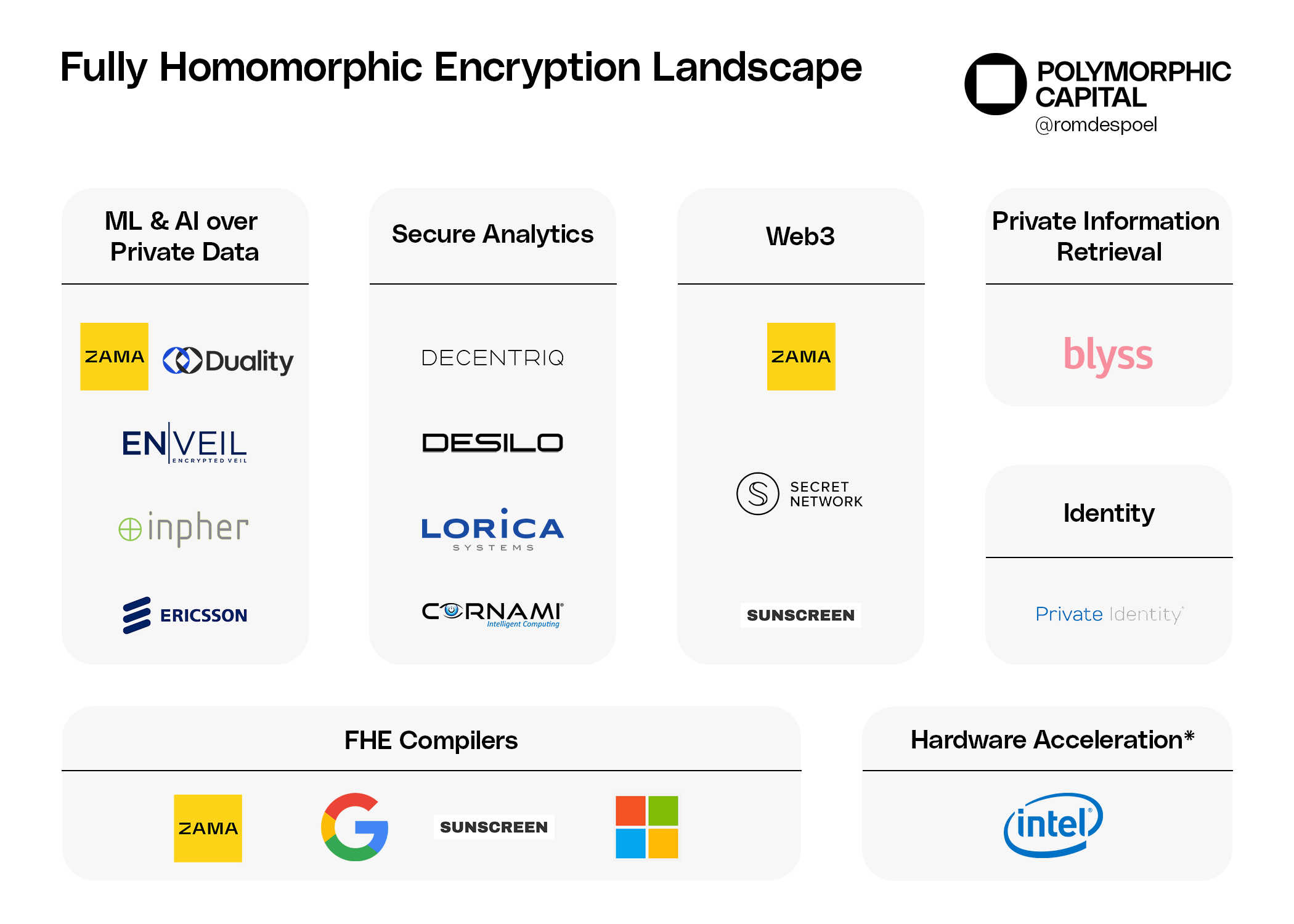
A majority of the work being done is still academic. Nevertheless, due to the importance of this emerging paradigm, every major company has FHE on their radar:
You will also find a handful of new companies specialising on the topic:
That’s all we have for you today! We are aiming for a series of articles that will demystify everything FHE and if there’s anything you’d like to see, or feedback on the article, please reach out on twitter @romdespoel.
*Hardware is a tough section to categorise. Due to the infancy and lack of standardisation, it’s very early to start focusing on hardware. Nevertheless, some advances in ZK hardware optimise operations like FFTs and MSMs which are also relevant for FHE. Companies working on this have been omitted.

.jpg)
.jpg)


