Why AI agents need an economic layer, and where stablecoins, programmable ownership and cryptographic verification can help build it.
The machine economy is an emerging system in which AI agents and autonomous machines execute economic tasks on behalf of people and organizations. Agentic commerce is one part of that system: agents discover, negotiate and purchase goods or services within delegated permissions. Our thesis is that economic execution (identity, authorization, payments, ownership, verification and coordination) will become a major infrastructure requirement as software takes on more of these tasks.
AI is turning software from a tool into an economic actor. As the cost of intelligence collapses, billions of agents and machines will increasingly make decisions, buy resources, allocate capital and transact with one another autonomously. The market is pouring trillions into the obvious infrastructure layers of this transition (compute, energy, models and robotics) while paying far less attention to the layer that turns machine decisions into economic actions. We believe this is a major blind spot. Finance is already one of the largest infrastructure stacks in the economy, comparable in scale to energy and compute; in a world with orders of magnitude more economically active agents and interactions, it will have to be rebuilt for machine scale. AI gives machines intelligence. Robotics gives them physical agency. The missing layer is economic agency.
Web3 is unusually well suited to provide it. Stablecoins give software native money; tokenization gives it ownership and collateral; smart contracts turn agreements into executable code; shared ledgers let independent machines coordinate without a common database owner; and modern cryptography makes it possible to prove identity, authority and computation without exposing sensitive data. What often looked like ideological design choices in crypto (programmability, permissionless access, “code is law,” verifiability and cryptographic privacy) increasingly look like engineering requirements for autonomous software. In Polymorphic Capital I, this was an early high-alpha theme alongside our core bets in stablecoins, tokenization and crypto infrastructure. In Polymorphic Capital II, we expect it to become one of our central investment areas: building the economic operating system for the machine economy.
In our previous letters, we focused on the two fastest-scaling real-world applications of Web3: stablecoin payments and tokenization. Both use blockchain to improve an existing financial system, making money more programmable and assets more portable. This letter looks further ahead: at the native economic infrastructure for a new economy increasingly populated by AI agents, autonomous software and machines.
The current AI buildout is usually framed around four layers: intelligence, compute, energy and robotics. All are essential. But if AI agents and machines become autonomous economic actors, a fifth layer becomes just as important: the financial and coordination infrastructure that allows them to act economically. AI is rapidly reducing the cost of intelligence and decision-making; robotics gives that intelligence the ability to act in the physical world. The next bottleneck is economic execution: how billions of autonomous actors receive authority, own and exchange resources, pay one another, verify outcomes, preserve privacy and coordinate across organizational boundaries. Today these functions are largely supplied by human institutions. In a machine economy, a growing share of them will have to become software. That is where the primitives developed by Web3 become unusually relevant.
Stablecoins: blockchain becomes money infrastructure.
Tokenization: blockchain becomes asset & finance infrastructure.
AI / Agent Economy: blockchain becomes coordination infrastructure for the machine economy.
The world is moving from AI that advises humans to AI that acts on their behalf. Today, AI already influences a growing share of consumer purchases, commercial decisions and financial workflows. The next step is delegation: agents that do not merely recommend what to do, but autonomously execute multi-step economic actions within a mandate.
Gartner forecasts that agentic AI will be embedded in 33% of enterprise software applications by 2028, up from less than 1% in 2024, and that at least 15% of day-to-day work decisions will be made autonomously. McKinsey estimates that AI agents could orchestrate $3–5 trillion of global B2C retail revenue by 2030; its estimate covers goods and excludes services and B2B. These are forecasts rather than observed outcomes. The underlying shift is that software is beginning to execute economic decisions as well as recommend them.
Sources: Gartner: Agentic AI forecasts (2025) · McKinsey: Agentic commerce opportunity · Mastercard Signals: Agentic commerce (2026)
Robotics gives AI access to the physical world. The global installed base of industrial robots reached roughly 5 million units in 2025, while shipments of professional service robots grew 24% to almost 250,000 units. At the same time, compute and energy are becoming strategic production inputs: the IEA expects global data-centre electricity demand to roughly double from 2025 to 2030, to around 950 TWh, with AI-focused data centres growing much faster than the total. Intelligence, compute, energy and physical execution are increasingly linked parts of the same economic system.
Sources: International Federation of Robotics: World Robotics 2026 · IEA: Key Questions on Energy and AI (2026) · IFR: Professional service robots, 2025 shipments
Every major economic transition, from agriculture to industry, from industry to services, and now toward an AI- and machine-driven economy, increases the number of specialized actors, the density of relationships between them and the frequency with which resources must be allocated. As economic structure becomes more complex, coordination becomes a larger economic function.
Money, prices, credit, insurance and capital markets are all mechanisms for coordinating decisions among independent actors that do not share the same information or incentives. At a high level, the financial system solves three recurring problems: who receives resources, when they receive them, and who bears the risk.
There is a useful historical signal in the growing economic weight of finance. Thomas Philippon reconstructs U.S. corporate financial services at roughly 1.1% of GDP in 1860, about 2% around the middle of the twentieth century, 4.2% in 1990 and 5.6% in 2007; his measure represented about 70% of the financial sector. A separate modern BEA series shows finance & insurance rising from 7.4% of U.S. GDP in Q1 2005 to 9.0% in Q2 2026. The series are not directly comparable, but both point in the same direction: as economic systems become more complex, more resources are devoted to coordinating capital, risk and exchange.
Sources: Thomas Philippon: Has the U.S. Finance Industry Become Less Efficient? · BEA/FRED: Finance & Insurance as % of GDP

Today the human economy consists of billions of economic actors and an enormous, but still human-paced, number of meaningful interactions. AI + robotics can expand both dimensions by orders of magnitude. One person or company may deploy hundreds of specialized agents; machines may continuously buy compute, data, energy, logistics, financing and services from one another; and transactions that are uneconomic today because of fixed operational overhead can become economically rational.
Illustrative scenario, not a forecast: an economy with 100× more economically active agents could require 1,000× more financial interactions.
Historically, the financial system scaled this coordination burden mainly by scaling institutions: more banks, more employees, more compliance, more reconciliation, more custodians, more clearing houses and more contracts. That model works when the number of economically meaningful decisions is bounded by human attention. It becomes much less plausible when software can make thousands of decisions per second.
The next financial system therefore has to scale computationally.
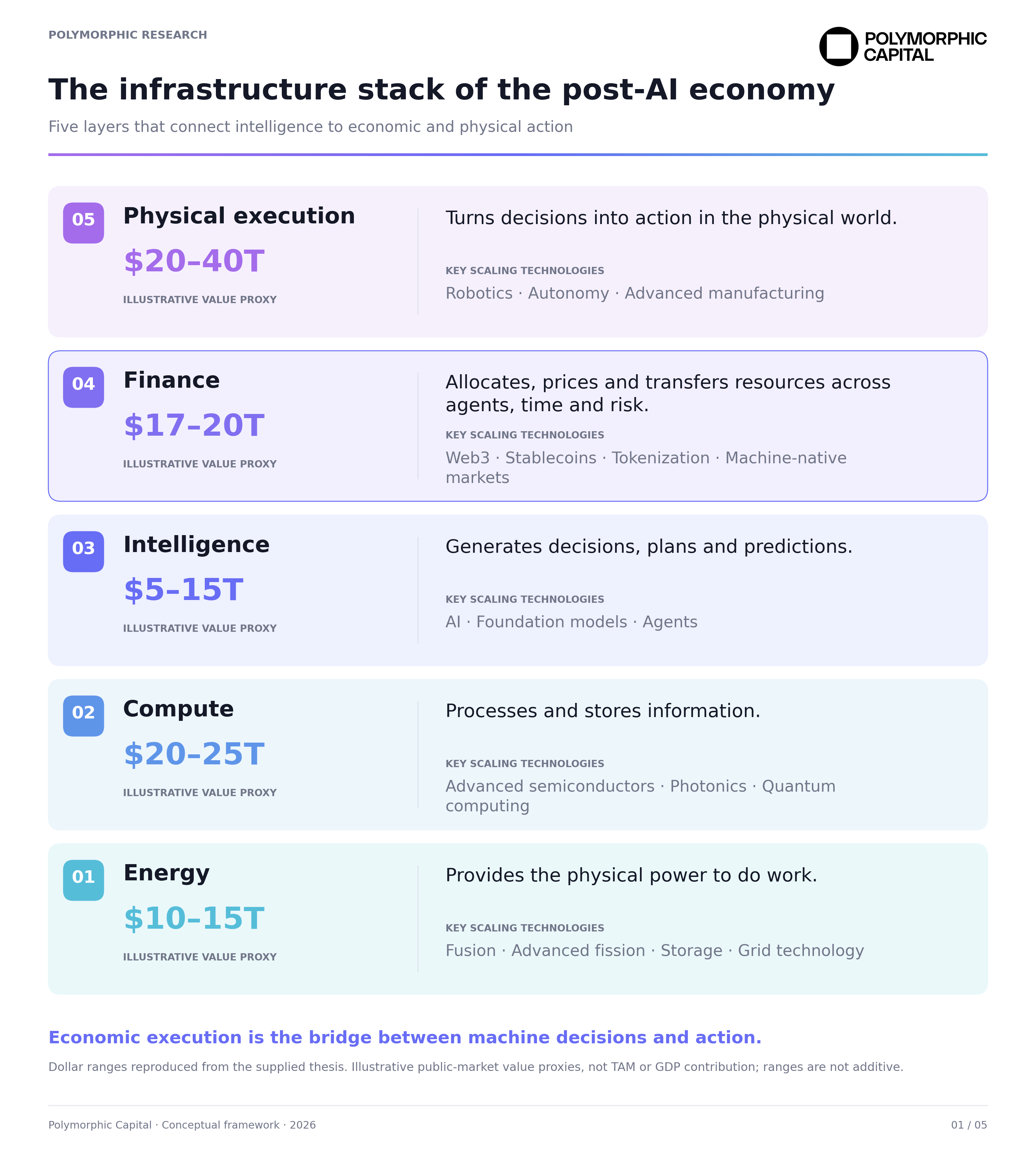
The five layers and their illustrative public-market value proxies:
This framing matters for investors. We view finance as one of the core infrastructure layers of the post-AI economy. The ranges above illustrate our framing; they do not establish a measured comparison of economic output or market opportunity. Every additional unit of machine intelligence that can act autonomously creates demand for identity, authority, payments, ownership, collateral, risk transfer and settlement. If AI changes how economic decisions are made, the infrastructure that turns those decisions into economic actions must also evolve.
As more financial activity moves onchain and more economic decisions are delegated to software, we believe models that can interpret financial behavior in real time can become an important intelligence layer for the machine economy.
Finance is civilization’s coordination infrastructure. As civilization becomes more complex, the amount of coordination it requires grows. For centuries we solved this by building larger and more sophisticated financial institutions. In an economy increasingly populated by software agents and autonomous machines, that model no longer scales. The next financial system must turn coordination from an institutional process into a computational primitive.
The modern internet and financial system were built for people and legal entities. In a world where a meaningful share of economic activity is performed by autonomous software and machines, a new class of participants needs machine-native ways to identify itself, receive delegated authority, own and exchange assets, pay, prove performance, preserve confidentiality and coordinate with counterparties it may never have encountered before. The IMF now treats this as a concrete payments-design problem, emphasizing the tension between probabilistic AI behavior and the deterministic requirements of authorization, settlement and finality.
Sources: IMF: How Agentic AI Will Reshape Payments (2026)
Today the financial system serves billions of people and hundreds of millions of organizations. AI can create orders of magnitude more economically active entities: personal agents, corporate agents, autonomous services, models and robots. Each can make not a handful of economic decisions per day, but potentially thousands. The design question therefore changes from “How do we make today’s finance slightly faster?” to “How do we build finance for orders of magnitude more agents and interactions?”
The current system is digital at the interface, but only partially software-native underneath. The typical stack is still:
accounts → institutions → databases → messages → reconciliation → legal enforcement
Software usually asks an institution to perform an action. A machine economy increasingly needs software to own, transfer, exchange and condition resources directly. The distinction is not simply digital finance versus analog finance; it is digital finance versus software-native finance.
The current system scales trust institutionally: “I do not trust you, but we both trust JPMorgan, Visa, DTCC, an auditor or a court.” That model scaled extraordinarily well from local commerce to a global economy. It is much harder to extend to billions of autonomous agents that cannot open a new banking relationship, negotiate a bespoke contract, perform due diligence and rely on legal enforcement for every short-lived interaction.
Machine-native finance therefore needs a layer in which part of institutional trust is replaced by verifiable state, cryptographic proof and programmable rules.
Traditional finance scales trust institutionally. Machine-native finance has to scale trust computationally.
Autonomy makes confidentiality a first-order infrastructure problem. A useful personal agent may know the user’s payment credentials, budget, location, preferences and identity. A corporate agent may know supplier pricing, inventory, margins, credit limits and proprietary forecasts. Simply copying those inputs into a shared database, or exposing them to every counterparty, is not a viable architecture. The system needs selective disclosure: prove that an agent is authorized, solvent or compliant without revealing the underlying private information. The IMF explicitly identifies privacy and data security as key risks in agentic payments because autonomous agents must interact with external model endpoints, clouds and financial services while handling sensitive credentials and data.
Sources: IMF Note: privacy and data-security risks in agentic payments
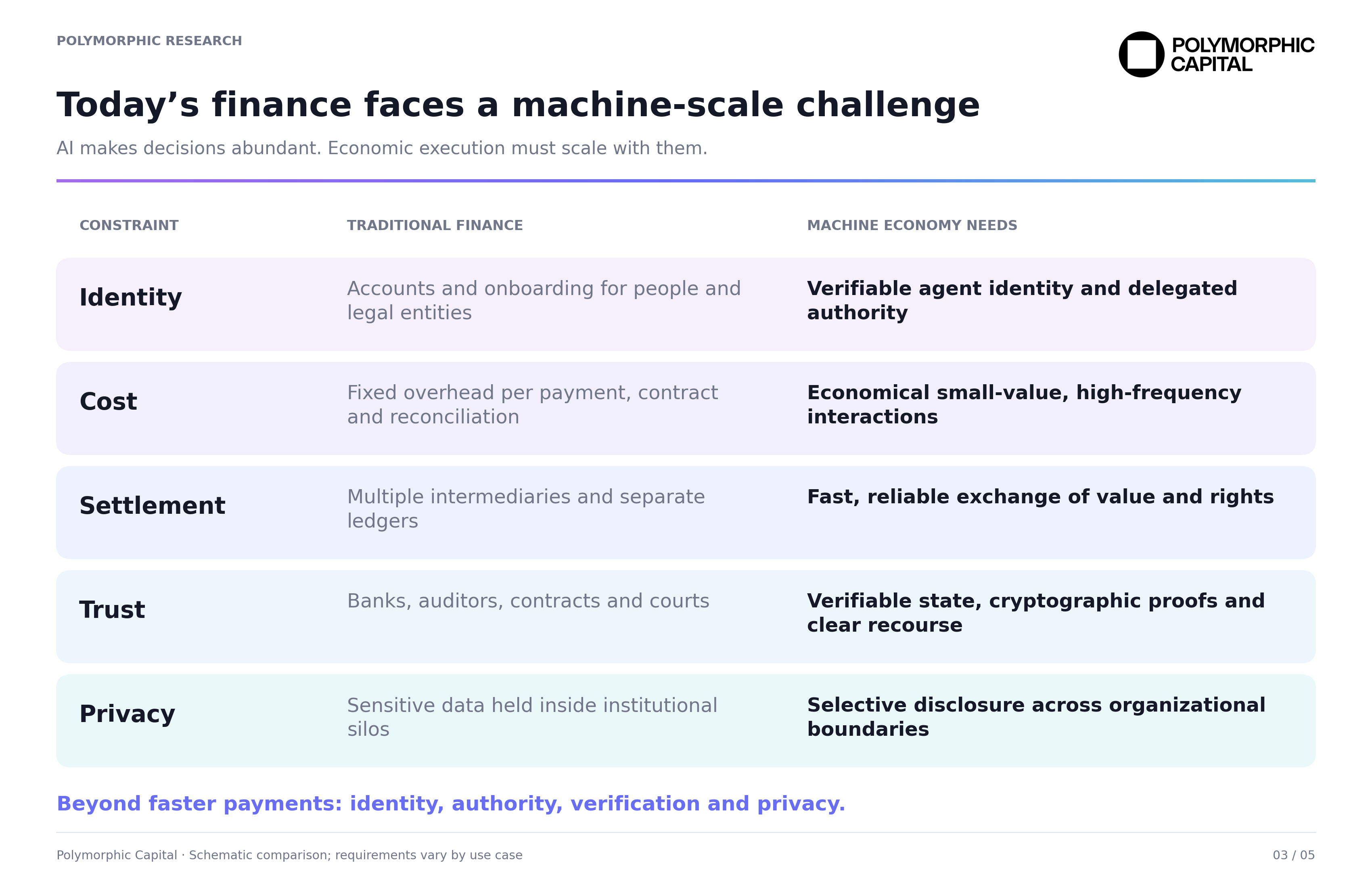
In more detail, the gaps between traditional finance and what a post-AI economy requires:
The following scenarios are hypothetical illustrations of the infrastructure requirements, rather than descriptions of deployed systems or adoption forecasts.
In 2035, a user tells a personal agent: “Organize two weeks in Japan in April. Budget €8,000. I want good hotels, a few restaurants, a ski trip in Hokkaido and as few connections as possible. Optimize the itinerary and rebook things if plans change.” The intelligence problem is close to being solvable: the agent can search, compare and plan. The hard part is economic execution.
The agent must prove that it is authorized to spend up to €8,000 but not €20,000; reserve funds without receiving unlimited access to the user’s bank account; coordinate refundable and conditional bookings across airlines, hotels and local services; handle cross-border payments and refunds; and do all of this without exposing the user’s full identity, preferences and financial data to every merchant. A machine-native version looks more like a programmable mandate: “Spend up to €8,000, only on travel, during these dates, subject to these constraints.” Payments, escrow, refunds and permissions then execute around that mandate.
A production AI detects that an EV manufacturer will face a shortage of power-electronics components in three weeks. It increases the component order, books additional manufacturing capacity and freight, arranges working-capital financing, hedges FX and insures the shipment. Today those legs live in separate systems: ERP → bank → supplier bank → logistics platform → insurer → market infrastructure → accounting, followed by reconciliation.
For real-time machine coordination, the transaction needs to become more atomic: “Pay supplier $420k if verified shipment X reaches warehouse Y before date Z; simultaneously transfer title, release $300k of inventory financing and close the FX hedge.” The parties should be able to verify inventory, delivery, collateral and authority without disclosing every commercial term or internal dataset to one another.
Now scale the same logic to millions of solar panels, home batteries, EVs, data centres and industrial plants, each represented by an agent. At 14:07, demand spikes and renewable output falls. An EV is willing to sell 12 kWh if the price exceeds €0.34/kWh; a battery will sell 7 kWh while preserving 30% state of charge; a data centre can shift 15 MW of load for a defined price. A market has to match millions of changing bids, verify physical constraints, clear the price and settle the result in near real time. The challenge is no longer payment alone; it is the coordination bandwidth of the economy.
In a more machine-readable economy, autonomous capital agents could continuously evaluate demand, inventory, cash flow, supply-chain risk, weather and energy prices, and reprice capital accordingly. Financing might exist for one shipment, insurance for one robot trip, or revenue-sharing for one API call. As financial instruments become more granular and short-lived, the traditional sequence (originate → document → approve → custody → settle → reconcile) becomes too expensive relative to the underlying activity. Capital markets begin to look less like periodic institutions and more like real-time protocols.
Across all four scenarios, the same thing happens: AI makes decision-making dramatically cheaper, so the bottleneck moves downstream to economic execution.
AI makes decisions abundant.
The financial system still makes execution scarce.
The recurring bottlenecks are also the same: identity → authorization → trust → ownership → payment → settlement → collateral → verification → privacy → dispute resolution.
The machine economy does not merely need faster payments. It needs an economic operating system capable of coordinating billions of autonomous actors.
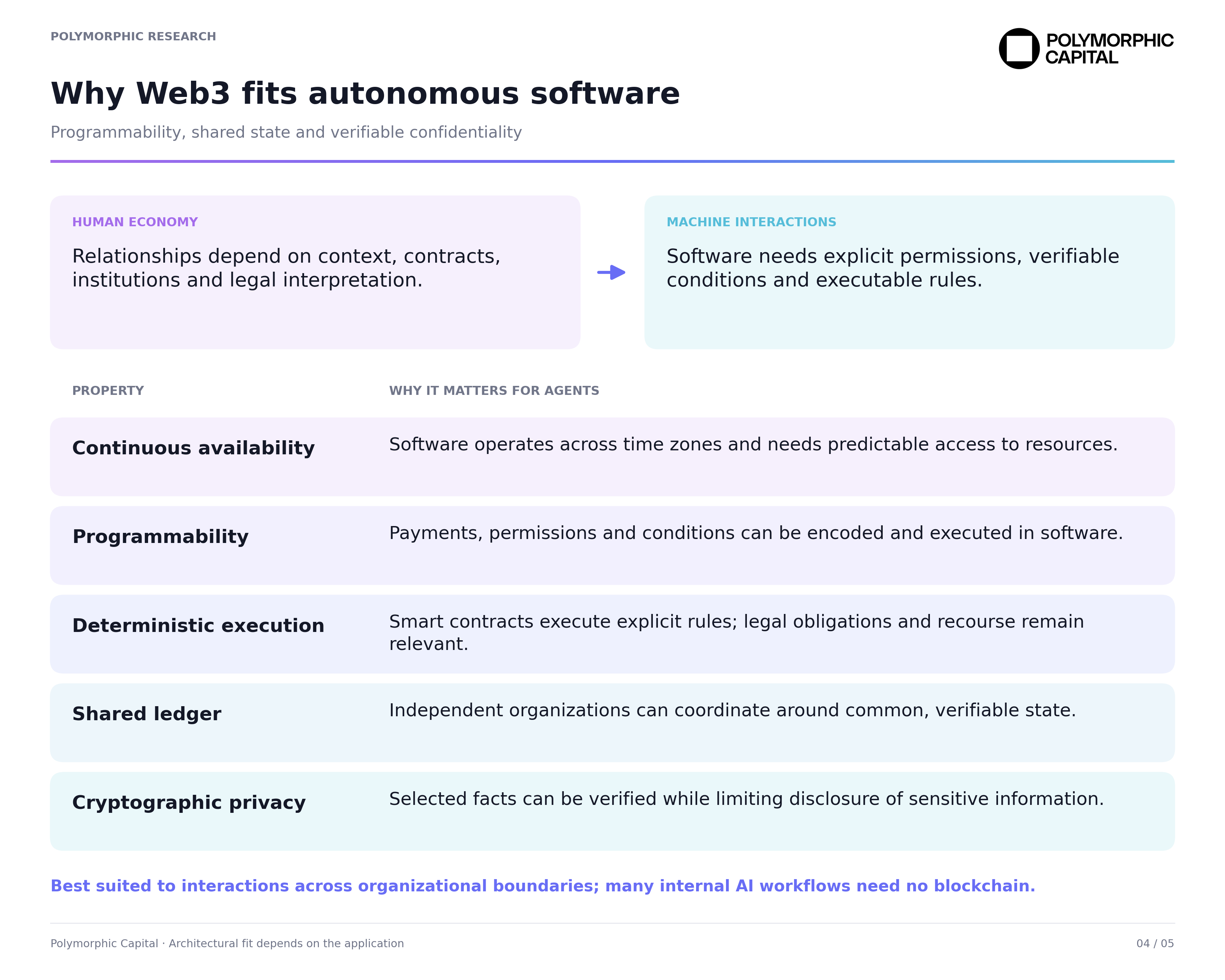
This is where Web3 becomes particularly relevant. Many of the properties that were useful but not always essential in a human-centric economy become almost native requirements in a machine economy: instant settlement, global accessibility, programmability, verifiability, composability and a shared source of truth. What looked like ideological design choices in crypto increasingly look like engineering requirements for autonomous software. Software agents do not need paperwork, business hours or institutional relationships; they need deterministic rules they can discover, verify and execute in milliseconds. The old crypto idea of “code is law” has always been difficult to apply literally to human relationships, which are ambiguous, contextual and full of exceptions. For machines, the opposite is true. Machines are built to interact through explicit rules. A smart contract (if X is verifiably true, transfer Y under conditions Z) is far closer to their native mode of interaction than a legal agreement interpreted after the fact by institutions and courts. What often felt overly rigid in the human economy may become a feature in the machine economy.
There is an important second-order effect. A machine economy cannot simply put every interaction, credential and piece of data onto a transparent ledger. AI agents will operate on some of the most sensitive information in the economy: personal preferences and payment credentials, corporate pricing and inventory, proprietary datasets, trading strategies and internal forecasts. Conveniently, Web3 has spent more than a decade confronting exactly this tension: how to make state and computation verifiable without making all underlying information public. The result is one of the most advanced applied cryptographic toolkits available today: zero-knowledge proofs, multi-party computation, homomorphic encryption, trusted execution environments and increasingly sophisticated combinations of them. The architecture the machine economy needs is therefore not radical transparency, but something more powerful: programmable and verifiable economic interactions with selective disclosure and private computation.
These technologies have different trust assumptions. Zero-knowledge proofs verify specific statements; MPC distributes computation across parties; FHE supports computation on encrypted inputs; trusted execution environments depend on hardware and implementation security. They do not automatically make an entire system private, safe or compliant. Delegation also does not remove the legal responsibilities of the person or organization behind an agent.
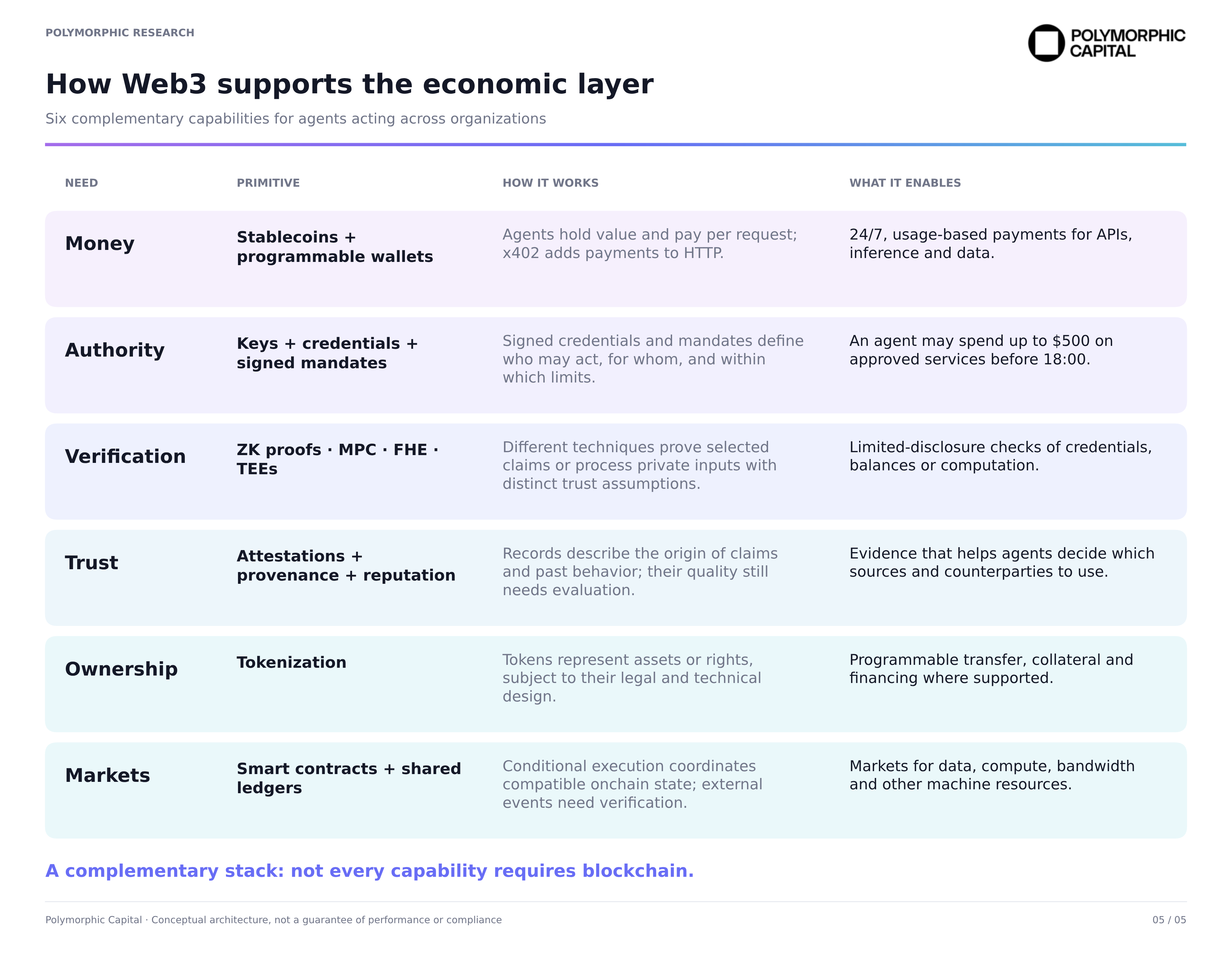
Stablecoins + programmable wallets give software the ability to hold value and make payments 24/7 without a human checkout flow. This matters because a machine economy naturally creates large numbers of very small transactions: API calls, inference, data, compute, bandwidth, energy, robot services and other pay-per-use resources. Traditional payment economics become awkward when the transaction itself is worth cents or fractions of a cent.
A standards race for machine commerce is already underway. x402 embeds payment into HTTP requests. Stripe and Tempo introduced the Machine Payments Protocol (MPP) in March 2026. Google’s Agent Payments Protocol (AP2) addresses agent payment authorization, and OpenAI and Stripe’s Agentic Commerce Protocol (ACP) supports agent-mediated commerce. These initiatives demonstrate growing interest in commerce executed by software, although they use different architectures and do not all require blockchain. The protocols and their adoption will continue to evolve.
Sources: x402: internet-native payments · Visa: Agentic Payments: What Onchain Data Reveals · Stripe + Tempo: Machine Payments Protocol · Google: Agent Payments Protocol / A2A x402 · OpenAI: Agentic Commerce Protocol
Nevermined is building the payments and monetization layer for the machine economy. Its infrastructure allows AI agents to autonomously pay and get paid for services, while giving their principals control over budgets and permissions. On the merchant side, Nevermined handles real-time metering, pricing, access control and settlement; on the buyer side, it enables delegated spending within predefined mandates. The platform supports both traditional and crypto rails and emerging machine-payment standards including x402 and MPP.
Polymorphic led Nevermined’s Pre-Seed round in 2022, well before agentic commerce became an established category. We doubled down in the company’s 2024 Seed round and continue to be actively involved through a board seat.
For several years, the team was effectively building ahead of the market, and frankly the product was difficult for many investors and potential customers to understand. That has changed dramatically over the past year. Revenue remains limited, reflecting how early agentic commerce itself still is, but recognition of the category, and of Nevermined’s position within it, has accelerated rapidly.
Nevermined reports that it was named in Gartner’s 2026 Coolest Vendor Innovations in Agentic AI for Banking, Part 1. As agentic commerce develops, the company is applying its infrastructure to delegated spending and machine payments. Source: Nevermined.
Machine identity is less about a passport and more about a cryptographically verifiable statement of authority: “I am Agent X, acting for Principal Y, with authority to spend up to $500 on task Z until 18:00.” Cryptographic identity, wallets and programmable permissions can turn a wallet into more than a payment container: it becomes a combination of identity, credentials, permissions, assets and transaction history.
The same need is appearing in mainstream protocols. Google AP2 uses cryptographically signed mandates to encode user intent and delegated authority. Visa’s Trusted Agent Protocol gives merchants a cryptographic mechanism for distinguishing legitimate authorized agents from bots and verifying the agent’s intent. The industry is converging on the idea that software needs portable, machine-readable authority.
Sources: Google AP2: mandates and authorization · Visa: Trusted Agent Protocol
Identity is also where the next constraint becomes obvious: verification often has to happen without disclosure. An agent may need to prove that a credential or attribute is valid without revealing the underlying identity or data.
TACEO is building a private shared compute environment for sensitive data. Its largest production use case today is identity: Sam Altman’s World, ZKPassport, Boop and others use TACEO to match identity-derived data without any party seeing the underlying information.
The same architecture is now being extended to finance and AI agents. If machines are going to transact using sensitive balances, pricing, credentials and proprietary strategies, they need infrastructure that can compute and verify over private data without revealing it.
Polymorphic invested in TACEO’s Seed round in 2025 alongside a16z and Archetype. We see its identity deployments as an important proof point that advanced cryptography can operate at real-world scale and potentially become a critical privacy layer for the machine economy.
This may be the deepest part of the thesis. If one AI tells another, “I computed this correctly,” “I have sufficient collateral,” or “this shipment satisfies the agreed condition,” “trust me” does not scale to billions of autonomous systems. Machine commerce needs ways to prove that computation occurred, that the relevant input satisfied a constraint, that an output is valid, and that a counterparty performed, ideally without disclosing the private data behind the proof.
This is where zero-knowledge proofs, secure multi-party computation, fully homomorphic encryption, trusted execution environments and verifiable computation become economic infrastructure rather than cryptographic curiosities. NIST’s privacy-enhancing cryptography program explicitly treats ZKPs, MPC and FHE as core tools: ZK can prove a statement without revealing the secret behind it; MPC allows parties to compute over joint inputs without sharing those inputs; FHE allows computation over encrypted data. In a machine economy, the useful primitive is often not “public transparency” but verifiable confidentiality.
Sources: NIST: Privacy-Enhancing Cryptography · NIST: Zero-Knowledge Proofs · NIST: Multi-Party Computation · NIST: Fully Homomorphic Encryption
Fair Math is building the infrastructure layer for privacy-preserving computation. Technologies such as FHE allow software to compute directly over encrypted data, which is potentially critical for AI agents that need to process sensitive personal or corporate information without exposing it.
Its FHERMA platform provides an environment for developing, benchmarking and optimizing advanced cryptographic computation. Fair Math works with NVIDIA on optimizing cryptographic primitives for NVIDIA GPUs, making privacy-preserving computation dramatically more practical on modern compute infrastructure, and with IBM on implementations of various FHE primitives.
Polymorphic was the lead investor in Fair Math’s Seed round. As private computation becomes a core requirement for AI and the machine economy, we believe the infrastructure making advanced cryptography faster, cheaper and accessible to ordinary developers can become an important part of the stack.
The LLM internet creates a second-order problem: the marginal cost of creating information approaches zero while the value of provenance, attribution and reputation rises. In a human internet, search engines and brands could approximate authority. In an agentic internet, a machine has to decide which agent, dataset, model, claim or source it trusts enough to act on, and often enough to pay for. Before an agent buys a dataset, hires another agent or acts on a claim, it needs a machine-readable answer to a simple question: why should I trust this? Persistent attestations, provenance and machine-readable reputation therefore become economic infrastructure.
Intuition is building a trust and knowledge layer for humans and AI agents. As AI makes information creation nearly free, the scarce resource shifts from information itself to provenance, context and trust: knowing where a claim came from, what supports it and whether it should influence a decision.
Intuition is building an open knowledge graph where identities, claims, reputation and economic signals can be shared across applications. For AI agents, this creates a machine-readable way to discover information, inspect provenance and decide which sources, claims or other agents to trust.
The protocol has already seen meaningful early adoption. Its Base beta attracted 244,000+ participants, who created 5.1 million attestations across 5.3 million transactions.
If AI agents become economic actors, their workflow increasingly looks like: discover → negotiate → contract → transact → settle → verify → build reputation. A large machine-to-machine marketplace emerges. Blockchain is relevant here not because “decentralization is good,” but because there is often no natural candidate to own the canonical database when autonomous systems belonging to different companies need to exchange value, rights and proofs.
Embed is building behavioral foundation models for financial decision-making. Unlike LLMs, which learn primarily from language, its models learn from what people and organizations actually do: transactions, trading activity, cash flows and other behavioral data available onchain.
The company is now applying this technology to credit scoring, fraud detection and cash-flow prediction, combining proprietary institutional data with onchain transaction data. Its first major deployment is with Tala, a fintech lender serving more than 14 million users and having originated over $9 billion in loans, where Embed is building an AI-native credit model and onchain orchestration layer.
The same logic applies to the core resources of the machine economy itself. Data, compute, models, inference, bandwidth and eventually energy become continuously tradable inputs that agents need to discover, price and purchase. These markets are global by nature, their supply is fragmented, demand is software-driven, and transactions may be extremely granular. Web3 has historically been particularly effective at bootstrapping new markets: tokens can incentivize distributed supply, open protocols create global access, and programmable settlement allows resources to be bought and sold continuously without requiring every participant to integrate with the same intermediary.
This is an opportunity to build these markets natively for software from day one: global, programmable, composable and capable of settling in real time, rather than forcing them into infrastructure designed around human commerce. The machine economy will need not only machine-native money, but machine-native markets for its fundamental resources.
This is the key boundary of the thesis. We should not claim that the AI economy will run on blockchain. Most AI activity will not need one. If an internal agent operates inside one company and one trusted database, a blockchain may add no value at all.
The case for blockchain emerges when autonomous actors cross organizational boundaries. Once agents belonging to different users, companies or machines need to transact, coordinate or establish trust without relying on a single shared institution or database, the requirements change.
Whenever autonomous machines need to transact, coordinate or establish trust across organizational boundaries, blockchain becomes a uniquely natural infrastructure.
What makes it particularly well suited is not any single feature, but the combination of primitives it brings together: stablecoins provide software-native money; tokenization creates software-native ownership and collateral; smart contracts provide programmable settlement; shared ledgers create common state without requiring a common database owner; cryptographic credentials provide portable authority; and privacy-enhancing cryptography makes it possible to verify facts and execute logic without exposing the underlying data.
Individually, none of these capabilities requires blockchain. Together, however, they form a remarkably complete coordination stack for autonomous economic actors.
Web3 can therefore be understood less as a standalone industry and more as a set of protocols for a world in which humans and legal entities are no longer the only economically active actors. Stablecoins answer how value moves. Tokenization answers what software can own and exchange. The agent economy adds the third question: how autonomous economic actors coordinate.
The investment opportunity is not simply “AI + crypto.” It is the rebuilding of financial and coordination infrastructure for a world in which software becomes an economic actor. The largest long-term opportunity for Web3 may therefore not be putting today’s economy onchain, but providing the native economic infrastructure for an economy increasingly populated by autonomous software and machines.
In Polymorphic Capital Fund I, the machine economy was primarily a discovery / early high-alpha theme rather than a core allocation, simply because the market itself did not yet meaningfully exist. The majority of the Fund’s capital was deployed into more established opportunities across stablecoin payments, tokenization and RWA, and core crypto infrastructure, areas that we continue to expect to drive the bulk of Fund I returns. At the same time, we made a number of early bets on companies building pieces of what we now see as the emerging machine-economy stack. These investments remain early, but we believe several have the potential to become significant companies and provide meaningful additional upside to the Fund.
In Polymorphic II, we expect this theme to move from exploratory to central. The infrastructure enabling AI agents and machines to transact, coordinate, verify and operate economically will be one of the Fund’s core investment areas.
AI gives machines intelligence. Robotics gives them physical agency. Web3 gives them economic agency.
It is the infrastructure that allows AI agents to execute economic actions: prove delegated authority, pay for resources, exchange rights, verify outcomes and coordinate with counterparties.
Stablecoins can provide programmable, continuously available settlement for agents purchasing services across organizations. They are one possible payment rail; agentic commerce can also use cards and bank-based payments.
No. An agent operating inside a single organization with a trusted database may gain little from blockchain. Shared ledgers become more useful when independent participants need common state and programmable settlement.
Depending on the task, zero-knowledge proofs, secure multi-party computation, fully homomorphic encryption and trusted execution environments can help verify claims or process sensitive inputs with limited disclosure. Their security and performance depend on the design.
The portfolio examples in this article are Nevermined for agent payments, TACEO and Fair Math for private computation, Intuition for provenance and trust, and Embed for financial behavioral models.